
Endurance Racing Terms Every Fan Should Know | A Beginner's Guide to Speaking the Language of Motorsport
Endurance Racing Terms
One of the biggest challenges for new endurance racing fans isn't understanding the cars—it's understanding the language.
Watch a race for just a few minutes and you'll hear commentators talking about fuel windows, stint lengths, undercuts, Balance of Performance, traffic management, and full-course yellows. If you're new to the sport, it can feel like everyone else knows something you don't.
The good news?
Once you understand the basic terminology, endurance racing becomes much easier—and much more enjoyable—to follow.
Here are some of the most common endurance racing terms every fan should know.
Endurance Racing Terms
Stint
A stint is the period a driver spends in the car before making a pit stop or handing the car over to a teammate.
In endurance racing, a driver will complete several stints throughout the race, depending on fuel strategy, tire wear, and regulations.
Pit Stop
A pit stop is when a car enters pit lane for fuel, new tires, repairs, or a driver change.
Unlike many other forms of racing, pit stops are often where endurance races are won or lost.

Driver Change
Most endurance races require multiple drivers to share the same car.
During longer events like the 24 Hours of Le Mans or the CrowdStrike 24 Hours of Spa, teams rotate drivers throughout the race to manage fatigue while staying within series regulations.
Fuel Window
A fuel window refers to the number of laps or amount of time a car can complete before it must refuel.
Teams constantly calculate fuel windows to determine the ideal moment to pit and maximize track position.
Traffic Management
Because multiple classes race together, faster prototype cars regularly catch GT cars.
Knowing how and when to pass slower traffic safely is called traffic management, and it's one of the most important skills in endurance racing.
Many races are decided not by outright speed, but by how efficiently teams navigate traffic.
Multi-Class Racing
One of endurance racing's defining features.
Different classes of cars compete on the track at the same time while racing for separate class victories.
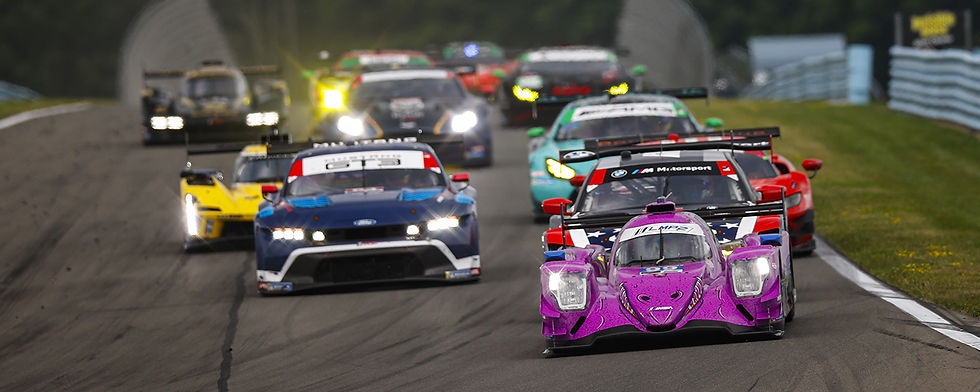
For example, a Hypercar may be fighting for the overall win while an LMGT3 or GTD car is battling for victory in its own category.
Balance of Performance (BoP)
Balance of Performance, often shortened to BoP, is a system used to keep different manufacturers competitive.
Series organizers adjust factors such as weight, engine power, or ride height to help create close racing despite the different designs of each car.
Full-Course Yellow (FCY)
Instead of stopping the race, officials may deploy a Full-Course Yellow, requiring every car to slow to a controlled speed while an incident is cleared.
This allows marshals to work safely without immediately bringing out a safety car.
Safety Car
When track conditions require greater intervention, the Safety Car leads the field while the race remains neutralized.
Pit strategy during Safety Car periods often reshuffles the running order and can dramatically change the outcome of a race.
Undercut & Overcut
An undercut happens when a team pits earlier than a rival to gain time on fresh tires.
An overcut is the opposite—staying out longer in the hope that clean air and consistent pace will create an advantage.
Choosing the right strategy can be the difference between winning and finishing off the podium.
Pole Position
The driver who sets the fastest qualifying lap starts from pole position, earning the first grid spot for the race.

While pole is important, endurance races are rarely decided by qualifying alone.
Class Victory
Not every team is racing for the overall win.
Many competitors focus on winning their own category, making a class victory just as significant as an overall triumph.
This is one of the reasons endurance racing offers so much action throughout the field.
First Sector Verdict
Learning endurance racing terminology is like learning a new language.
At first, the words may sound unfamiliar.
But once you understand how strategy, pit stops, traffic, and teamwork all fit together, the sport becomes even more exciting to watch.
The next time you tune into IMSA, the FIA World Endurance Championship, GT World Challenge, or the 24 Hours of Le Mans, you'll hear more than racing commentary.
You'll understand the story unfolding behind every lap.


Comments